
Everyday Norwegian food: from brown cheese to Taco Friday
Norwegian food is not famous for being exciting, but it says a lot about the country: a simple lunch, plenty of fish and lamb, and a few habits that surprise almost everyone who moves here. Here is what you will actually eat – and how to shop and order in Norwegian.

Brown cheese and the packed lunch
Brunost is not really cheese but caramelised whey. It tastes sweet, a bit like fudge, and is cut into thin slices with an ostehøvel, a cheese slicer patented in 1925 by Thor Bjørklund from Lillehammer. The most common kind is Gudbrandsdalsost; geitost, pure goat's cheese, is stronger.
For lunch most people eat a matpakke: two or three slices of bread with toppings, wrapped in paper with a sheet of mellomleggspapir between the slices. Children take it to school, adults to work, and it is usually eaten cold at the desk around 11:30. A hot lunch is not common. Many people have dinner as early as 4 or 5 pm.
Popular toppings are brown cheese, mackerel in tomato sauce, liver pâté and Norvegia cheese. Try it before you judge it – many people who move here end up making their own matpakke after a few months.
Fårikål, lutefisk and Taco Friday
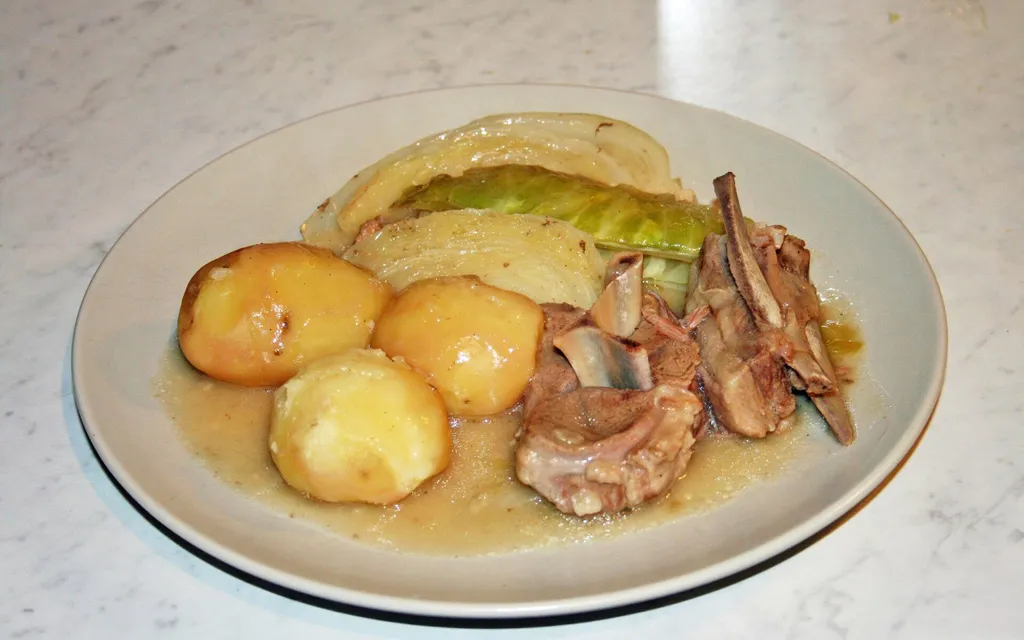
Fårikål has been voted Norway's national dish, most recently in a 2014 poll. It is layers of lamb or mutton and cabbage with whole black peppercorns, simmered for hours and served with potatoes. It is an autumn dish, and the last Thursday in September is Fårikål Day.
Lutefisk is dried cod soaked in lye and then rinsed in water again. It turns jelly-like and is served around Christmas with bacon, mushy peas, potatoes and mustard. Plenty of Norwegians don't like it either – it is perfectly fine to say «nei takk».
The real everyday classic, though, is taco-fredag. Almost every Friday a huge number of families eat tacos: minced beef with a spice mix, soft tortillas or shells, sour cream, sweetcorn, cucumber and grated cheese. It is not Mexican, it is Norwegian. If you are invited for «fredagstaco», you have become one of the group.
Waffles and buns
Norwegian waffles are thin and soft, cooked in a heart-shaped iron. They are eaten with jam and sour cream or with a slice of brown cheese. You will find waffles at a dugnad (community work day), at kindergarten, in DNT cabins and during the break at many workplaces – often on Fridays.
Cinnamon buns are everywhere, but in Bergen the skillingsbolle is a subject of its own. It is a large, flat cinnamon swirl, often with sugar on top. The name comes from the fact that it once cost one skilling, an old coin. Many people from Bergen have firm views on which bakery makes the best one.
In Eastern Norway people are more likely to buy a raisin bun or a skolebolle: a sweet bun with vanilla custard in the middle and icing and coconut on top. Almost every bakery and kiosk has them, and they are a good excuse to practise: «En skolebolle, takk.»
Prices, Vinmonopolet and shopping tips

Food is expensive in Norway, especially meat, cheese and alcohol. The discount chains Rema 1000, Kiwi and Extra are cheapest; Meny and Joker cost more. Many shops have apps with discounts, and products close to their date are often sold cheaply at the end of the day. Shops are mostly closed on Sundays, apart from small ones.
Beer up to 4.7 per cent alcohol can be bought in the supermarket, but only until 8 pm on weekdays and 6 pm on Saturdays – not at all on Sundays. Wine and spirits are only sold at Vinmonopolet, the state-owned chain. The age limit is 18 for drinks under 22 per cent and 20 for spirits, and you will often be asked for ID.
In restaurants service is included in the price and tipping is not expected, though many people round up. Tap water is free, and you usually pay at the table by card or with Vipps.
Useful phrases
- Kan jeg få regningen?Can I have the bill?
- Trenger du pose?Do you need a bag?
- Kan jeg betale med kort?Can I pay by card?
- Takk for maten!Thanks for the meal!
- Jeg vil gjerne ha en kaffe og en skillingsbolle.I'd like a coffee and a cinnamon bun.
- Er det noe kjøtt i denne?Is there any meat in this?
- Kan jeg få et glass vann?Could I have a glass of water?
- Nei takk, jeg er mett.No thanks, I'm full.
More about Norway

Norwegian dialects: why everyone speaks differently
Read the article →
Bokmål and Nynorsk: two written languages in one country
Read the article →
Small talk in Norwegian: weather, cabins and ‘takk for sist’
Read the article →
Working life in Norway: packed lunch, July holidays and a flat structure
Read the article →
Public holidays and time off in Norway: red days, fellesferie and holiday pay
Read the article →
The Norwegian year month by month: from dark January to New Year fireworks
Read the article →Skiing for beginners: cross-country, downhill and how to get started
Read the article →Hiking in Norway: a practical guide from planning to the cabin
Read the article →Free time in Norway: cabins, knitting, fishing and club life
Read the article →
Holidays in Norway: 17 May, Christmas, Easter and Midsummer
Read the article →
Friluftsliv: the right to roam, DNT cabins and mountain sense
Read the article →
The Sámi and Northern Norway: language, culture and Arctic light
Read the article →
Norway's regions, counties and cities
Read the article →
A short history of Norway
Read the article →
NAV, healthcare and tax: what you need to know
Read the article →
Everyday life in Norway: housing, prices and winter
Read the article →
Kindergarten and school in Norway
Read the article →
Art, literature and music
Read the article →
Sport in Norway
Read the article →
Everyday etiquette in Norway
Read the article →
Office culture in Norway: how an ordinary workday really works
Read the article →
Business in Norway: big companies, social partnership and business culture
Read the article →
Job hunting in Norway: from job ad to employment contract
Read the article →
Starting your own business in Norway: ENK, AS and the paperwork you need
Read the article →
Dating and relationships in Norway: from the first coffee to samboer
Read the article →
Norway's economy explained: oil, the krone, interest rates and jobs in 2026–2027
Read the article →Salaries in Norway: what people earn and how pay works
Read the article →
What does it cost to live in Norway? Rent, food, electricity and budgets for 2026
Read the article →