
Salaries in Norway: what people earn and how pay works
The average salary in Norway sounds high, but most people earn less than the average. Here you can see what the SSB figures for 2025 actually show, what common immigrant jobs pay, how the wage settlement and minimum wages work, and which rules apply to holiday pay, overtime and payment.
Average and median: two figures you should know
In 2025, average monthly earnings per full-time equivalent were NOK 62,070, while the median was NOK 55,800 (SSB). The median is the pay in the middle: half earn more, half earn less. Over 63% of jobs are below the average, because a few very high salaries pull it up. The median therefore says more about what is normal.
The figures refer to November and include agreed pay, irregular supplements and bonuses, but not overtime. ‘Per full-time equivalent’ means part-time pay is converted to a full-time job, so if you work 60%, you get roughly 60% of these figures. Monthly earnings rose 4.5% from 2024 to 2025. Annual pay rose a provisional 5.0% and prices 3.1%, so real wages went up 1.9% (SSB).
What is left after tax? We made a rough calculation with the 2026 tax rates (regjeringen.no). On NOK 45,000 a month (540,000 a year), tax comes to about NOK 124,000 a year, around 23%, leaving you roughly NOK 34,700 a month on average. On the median of NOK 55,800, tax is around 25% and net pay about NOK 41,800 a month on average. Deductions can change this, so use the tax calculator on skatteetaten.no.
Sector, gender, region and immigrants
In 2025, average monthly earnings were NOK 66,530 in central government, NOK 63,310 in the private sector and public enterprises, and NOK 55,080 in the municipalities (SSB). Municipalities employ many people in health, care, kindergartens and schools. Women earned NOK 57,690 on average and men NOK 65,610, so women's pay was 87.9% of men's (SSB). Part of the reason is that women and men often work in different occupations and sectors.
Pay also depends on where you work. By place of work, the average in 2025 was highest in Oslo at NOK 70,690, followed by Rogaland at 64,930 and Akershus at 62,760. Vestland stood at 60,800, Trøndelag at 59,700, Agder at 57,620, Nordland at 57,580 and Innlandet at NOK 55,710 (SSB). Remember that housing costs are also highest in and around Oslo.
In 2025, immigrants had average monthly earnings of NOK 55,180 and a median of NOK 48,910, compared with 64,150 and 57,930 for other residents (SSB). Employees not resident in Norway, for example on short assignments, had a median of NOK 46,910. Part of the gap reflects which occupations people work in, which is why it pays to get your education recognised and to learn Norwegian.
What do common jobs pay?
SSB publishes pay for more than 400 occupations. Here is the median monthly pay in 2025 for jobs where many immigrants work (SSB, table 11418). Hospitality and services: waiter NOK 37,350, kitchen assistant 38,140, office and commercial cleaner 41,180, cook 41,610, kindergarten assistant 41,610, shop assistant 42,020 and home help 42,370.
Construction, transport and industry: other building workers NOK 46,470, industrial labourer 47,090, lorry and trailer driver 47,260, bus driver 47,270, carpenter 47,900, warehouse worker 48,310, welder 50,500, construction machinery operator 51,510, plumber 53,750 and electrician 54,930. Health and childcare: health worker (helsefagarbeider) 51,430, kindergarten teacher 53,550 and nurse 57,830.
Notice the jump: a health worker with a trade certificate has a median about NOK 9,000 higher than a home help. Trade certificates, authorisation and Norwegian skills often mean better pay. Look up your occupation on ssb.no before you negotiate, so you know what is normal.
The wage settlement and the lead-sector model
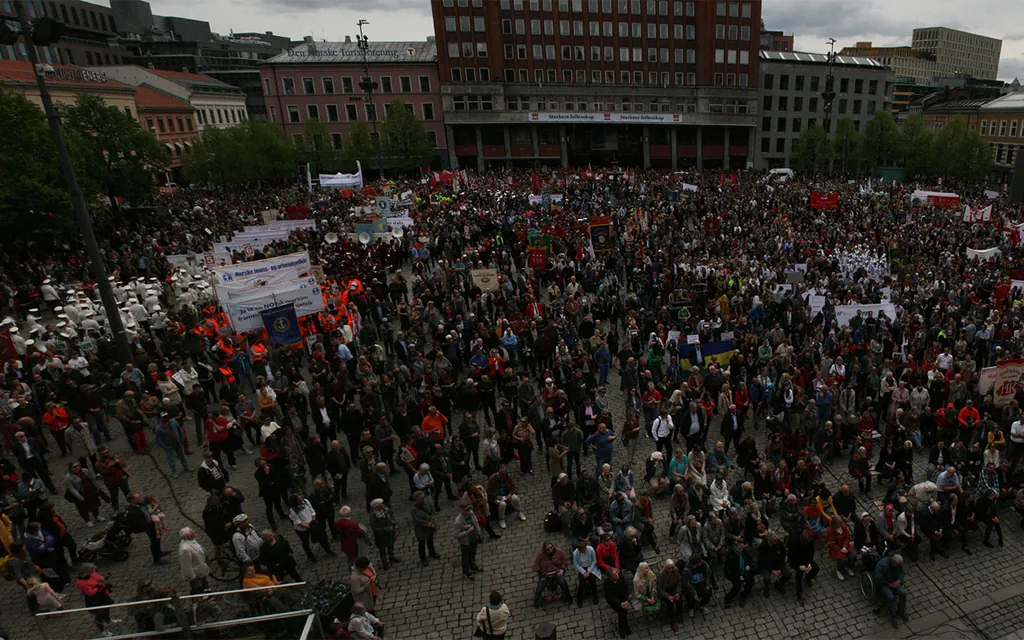
Every spring, unions and employers negotiate pay. Even years bring a main settlement (hovedoppgjør), where the whole collective agreement is negotiated, and odd years an interim settlement (mellomoppgjør), which is mostly about pay. Wage setting follows the lead-sector model (frontfagsmodellen): manufacturing that competes abroad negotiates first and sets the norm for the rest of the labour market.
In the 2026 main settlement, NHO, in agreement with LO, estimated annual pay growth in manufacturing at 4.4%. In 2025, overall annual pay growth ended at 4.9%, half a percentage point above the lead-sector frame (National Budget 2027). For 2027, both the government and Norges Bank expect pay growth of around 4%.
If your company has a collective agreement, you get the rise through the agreement. Without one, you have no automatic right to a pay rise and must ask for a pay review yourself. Ask colleagues or a union representative (tillitsvalgt) whether the company is bound by a collective agreement.
Minimum wages exist only in some industries
Norway has no statutory minimum wage for everyone. Instead, collective agreements are extended to all employees in certain industries, known as general application (allmenngjøring). According to the Labour Inspection Authority (Arbeidstilsynet), this covers nine industries: construction, electrical work, cleaning, hotels and restaurants, road freight, coach transport, agriculture and horticulture, shipbuilding and shipyards and, from 15 June 2026, the car trade. The regulation for fish processing was repealed on 3 August 2026, and a new proposal is being considered.
These are some of the rates Arbeidstilsynet listed in October 2026, in force since 15 June 2025: cleaning, over 18, NOK 236.54 an hour; unskilled construction work without industry experience 239.61, with at least one year's experience 249.00, and skilled construction workers NOK 264.32. In hotels and restaurants, the starting rate for people over 20 is NOK 204.79, and road freight in vehicles over 2.5 tonnes pays NOK 229.00.
At 37.5 hours a week, NOK 236.54 an hour gives roughly NOK 38,400 a month. The rates are adjusted regularly, so always check arbeidstilsynet.no for the current figures. If you are paid less than the minimum, contact Arbeidstilsynet or a union.
Holiday pay, overtime and supplements

You earn holiday pay (feriepenger) during one year and receive it the next, often in June. Under the Holidays Act the rate is at least 10.2% of what you earned the year before, and 12.5% if you are over 60. Collective agreements normally give 12% (Arbeidstilsynet). If you earned NOK 500,000 in 2025, you get at least NOK 51,000 in holiday pay in 2026, or NOK 60,000 at 12%. In your first year in Norway you have the right to holiday, but not to holiday pay if you did not work the year before.
Work beyond 9 hours a day or 40 hours a week is overtime under the Working Environment Act, and you are entitled to a supplement of at least 40% (section 10-6). At NOK 250 an hour, overtime is therefore at least NOK 350 an hour. In electrical work and shipyards, the generally applied agreements give 50%, and 100% at night and on Sundays and public holidays (Arbeidstilsynet).
Evening, night and weekend supplements are not required by law for everyone; they must be written into your employment contract or collective agreement. The exception is 1 and 17 May: if you work then, you are entitled to normal pay plus the same supplement as on Sundays, and at least 50% if nothing else has been agreed (Arbeidstilsynet).
How your pay is paid out
In Norway, pay is usually paid once a month, and the date must be stated in your employment contract. If nothing has been agreed, the law says pay must be paid at least twice a month (Working Environment Act section 14-15). As a rule, pay goes into your bank account, and you must always get a payslip. Not paying wages is wage theft and a criminal offence (Arbeidstilsynet).
Your employer deducts tax according to your tax card (skattekort). The deduction is spread over 10.5 months, so no tax is deducted from ordinary pay in June, and only half tax in November or December (Skatteetaten). Some foreign workers on short stays pay source tax (kildeskatt) instead, which in 2026 is 25% of gross pay (regjeringen.no). Check with Skatteetaten what applies to you.
Sources: ssb.no (wage statistics 2025, tables 11418, 11422 and 12524, ‘Hva er vanlig lønn i Norge?’), arbeidstilsynet.no (minimum wages, holiday pay, pay), lovdata.no (Working Environment Act sections 10-4, 10-6 and 14-15), regjeringen.no (National Budget 2027, tax rates 2026), skatteetaten.no (tax card and tax deductions).
Useful phrases
- Hva er timelønna?What is the hourly wage?
- Når er lønningsdagen?When is payday?
- Jeg har ikke fått lønnsslipp.I haven't received a payslip.
- Får jeg overtidstillegg?Do I get overtime pay?
- Er bedriften bundet av tariffavtale?Is the company bound by a collective agreement?
- Hvor mye får jeg i feriepenger?How much holiday pay will I get?
- Jeg vil gjerne ha en lønnssamtale.I'd like to have a talk about my pay.
- Lønna er lavere enn minstelønna i bransjen.The pay is lower than the minimum wage in the industry.
- Hvor mye får jeg utbetalt etter skatt?How much will I be paid after tax?
- Jeg jobber i full stilling.I work full-time.
More about Norway

Norwegian dialects: why everyone speaks differently
Read the article →
Bokmål and Nynorsk: two written languages in one country
Read the article →
Small talk in Norwegian: weather, cabins and ‘takk for sist’
Read the article →
Working life in Norway: packed lunch, July holidays and a flat structure
Read the article →
Public holidays and time off in Norway: red days, fellesferie and holiday pay
Read the article →
The Norwegian year month by month: from dark January to New Year fireworks
Read the article →Skiing for beginners: cross-country, downhill and how to get started
Read the article →Hiking in Norway: a practical guide from planning to the cabin
Read the article →Free time in Norway: cabins, knitting, fishing and club life
Read the article →
Holidays in Norway: 17 May, Christmas, Easter and Midsummer
Read the article →
Everyday Norwegian food: from brown cheese to Taco Friday
Read the article →
Friluftsliv: the right to roam, DNT cabins and mountain sense
Read the article →
The Sámi and Northern Norway: language, culture and Arctic light
Read the article →
Norway's regions, counties and cities
Read the article →
A short history of Norway
Read the article →
NAV, healthcare and tax: what you need to know
Read the article →
Everyday life in Norway: housing, prices and winter
Read the article →
Kindergarten and school in Norway
Read the article →
Art, literature and music
Read the article →
Sport in Norway
Read the article →
Everyday etiquette in Norway
Read the article →
Office culture in Norway: how an ordinary workday really works
Read the article →
Business in Norway: big companies, social partnership and business culture
Read the article →
Job hunting in Norway: from job ad to employment contract
Read the article →
Starting your own business in Norway: ENK, AS and the paperwork you need
Read the article →
Dating and relationships in Norway: from the first coffee to samboer
Read the article →
Norway's economy explained: oil, the krone, interest rates and jobs in 2026–2027
Read the article →
What does it cost to live in Norway? Rent, food, electricity and budgets for 2026
Read the article →