
 EN
EN Norsk
Norsk Polski
 Lietuvių
 Latviešu
 Українська
 Deutsch
 Română
 Español
Norskprøven, the Norwegian language test · levels, parts, price and registration
Norskprøven is the official Norwegian test for adult immigrants, and the result follows you to job interviews, university applications and UDI. Here is how the test works in 2026, which levels exist, what happens in each of the four parts, what it costs, how to register and how to prepare with the exercises on this site.

What Norskprøven is and who runs it
Norskprøven is a standardised digital test that gives adult immigrants official proof of their Norwegian. It is developed by HK-dir (the Directorate for Higher Education and Skills) for the Ministry of Labour and Social Inclusion, and it is taken at test centres in the municipalities, usually the local adult education centre (voksenopplæringen). There are two separate tests. Norskprøven A1-B2 measures four skills and gives each its own level, so one certificate can say B1 in speaking and A2 in writing. Norskprøven C1 is a separate and very demanding test at academic level. There is no syllabus and no grammar theory. The test checks whether you can use Norwegian in daily life, in education and at work. It is designed for people aged 18 to 67, and it can only be taken in Norway, never abroad.
The four parts at a glance
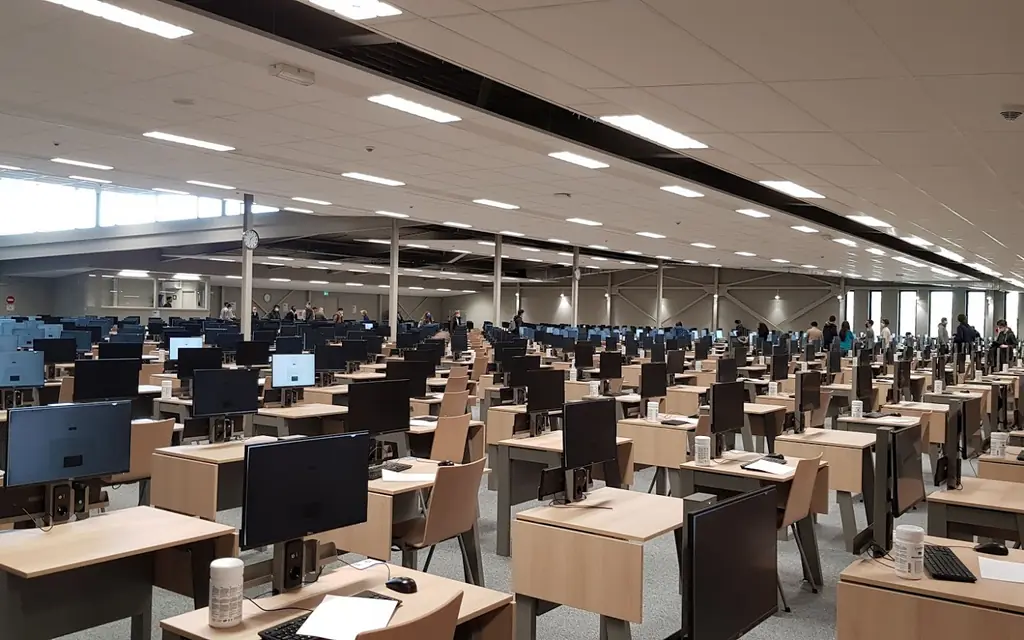
Norskprøven A1-B2 has four independent parts. Listening (lytteforståelse) takes 30 to 60 minutes, reading (leseforståelse) up to 75 minutes, and writing (skriftlig framstilling) 90 minutes at levels A1-A2 and A2-B1 or 120 minutes at B1-B2. These three are done on a computer, usually on the same day. The oral part (muntlig kommunikasjon) takes about 20 to 25 minutes and is often on another date. You decide how many parts to take, all four or only one, two or three. If you only need B1 oral for citizenship, you can register for the oral test alone. For writing and the oral test you choose a level when you register, A1-A2, A2-B1 or B1-B2. Listening and reading adjust to you during the test, so there you choose nothing. No aids are allowed, not even a dictionary, a phone or a smartwatch.
Listening and reading
Both tests start with two short pre-tests of 7 to 8 tasks each. The first is at A2 level, and your answers decide which second pre-test and which main test you get, an easy (A1-A2), a medium (A2-B1) or a hard (B1-B2) version with about 20 tasks. You meet easy and hard tasks along the way, so a hard test does not mean you are failing. In reading you manage the 75 minutes yourself and can go back to tasks you skipped. HK-dir advises spending no more than 10 to 15 minutes on each pre-test and reading the question before the text. In listening the program moves on by itself and you cannot go back. At A1 to B1 each recording and question is played twice, at B2 only once. A blank answer scores zero, just like a wrong one, so always answer. The possible results are under A1, A1, A2, B1 and B2.
Writing and the oral test
In writing you cannot get a higher result than the level you registered for, so choosing too low caps your result, while choosing B1-B2 too early is just as risky. There are three tasks at A1-A2 and A2-B1 and two at B1-B2, on topics every adult knows, such as family, school and work. Two trained sensors mark each text independently, and a third decides if they disagree. They check whether you answer the task, and they look at structure, spelling, punctuation, vocabulary and grammar. Texts learned by heart do not help, and handing in someone else's text counts as cheating. You write in Bokmål or Nynorsk. The oral test is usually a pair exam. You speak alone and then talk with another candidate, while an examiner asks the questions and a sensor listens. Here you can get a higher level than you chose, because the sensor may give you an extra question from the level above. Dialect is fine when you speak.
How to prepare for each part

Start with a level test on this site to see where you stand, then train each skill on its own. For listening, use our listening exercises with a female and a male native voice and answer before you look at the transcript, as in the real test. Play B2 items only once. Dictation trains listening and spelling together, because you type what you hear and see every word marked right or wrong. For writing, the Translate into Norwegian exercises and the sentence builder drill word order, which sensors judge as part of grammar. Write one short text a week on an everyday topic and keep ten minutes to check it. For the oral test, record yourself describing a picture or giving and justifying an opinion, two typical tasks. The oral prompts in our Bergenstesten section come with a recorder that never uploads your voice. Finally, do HK-dir's sample tasks on prove.hkdir.no with a timer.
Registration, price and dates in 2026
If you have the right and duty to Norwegian training, you can take every part free once, and your test centre signs you up. If you attend municipal Norwegian classes with collective protection from Ukraine, the municipality must also offer you a free final test. Everyone else registers and pays on prove.hkdir.no in a Monday to Friday window about five weeks before the test. Registration is binding, so you pay even if you stay away, unless you have a sick note. The municipality sets the price. HK-dir says one part often costs 400 to 1,200 kroner and all four 1,500 to 2,500 kroner. In 2026 the test periods were 9 to 13 March, 18 to 29 May, 21 to 25 September and 30 November to 4 December, with registration for the last one from 26 to 30 October. Many centres only take their own residents, but Lørenskog, Larvik, Øvre Eiker and Trondheim also accept people from other municipalities, and the first three also people who live abroad.
Results, certificate and appeals
Results for all parts come at the same time by e-mail, about three weeks after the test period. For the winter round of 2026 they are due on 7 January 2027. You can also see them on Min side at prove.hkdir.no. The certificate (prøvebevis) comes by post a few days later. Keep it safe, because only your test centre can send you a copy. To show your results to an employer or a university, log in to Vitnemålsportalen with ID-porten (BankID or MinID) and share a secure link. You can only appeal the writing result, within four weeks after results are out. Two or three new sensors then mark your text, and the result can go up, stay the same or go down. You cannot appeal again after that. Technical problems on the test day are a separate complaint about formal errors, which you must send within three weeks of the test.
Special arrangements and retakes
You can always adjust the sound and text size on the test computer without asking anyone. For other needs, such as dyslexia, poor sight or poor hearing, you apply to your test centre with a statement from a doctor, psychologist, speech therapist or the PP service. Do it as soon as possible and at the latest three days after you register. Possible arrangements include extra time, your own room, a paper test, a version for visually impaired candidates, an oral test without a partner and reading and writing software such as Lingdys or IntoWords, but no dictionary and no speech to text. Practise with the software well before the test. Retakes are simple. You can take one or more parts again in a later period, and the latest and best result is shown on your certificate. You may not take the same part twice in one period, even at another level, because only the first attempt counts. If you retake, you register and pay yourself.
Norskprøven C1 and Bergenstesten
Norskprøven C1 (høyere akademisk nivå) is a separate test with two parts. Listening and writing takes 2 hours 30 minutes and includes a summary of a long conversation in no more than 350 words and an argument text of 300 to 400 words. Reading and oral gives you 30 minutes to prepare and 15 to 20 minutes of examination. The result is either C1 or not passed, and the test runs twice a year, in 2026 on 1 and 2 June and on 7 and 8 December. Bergenstesten (Test i norsk, høyere nivå) is a different test run by Folkeuniversitetet. It measures B2 and C1, and some sessions are held abroad, which Norskprøven never is. For citizenship UDI accepts the oral part of both. If you aim for A2, B1 or B2, Norskprøven is the natural choice, because it shows your level even when you fall short. If you aim for C1, read our Bergenstesten section.
Sources
All facts were checked on 17 October 2026 on these official pages.
HK-dir, prove.hkdir.no · Norskprøve A1-B2, pages Les om prøven, Om leseprøven, Om lytteprøven, Om skriveprøven, Om muntlig prøve, Øv til muntlig prøve, Når er prøven?, Meld deg på, Be om tilrettelegging, Finn resultatet ditt, Muligheter til å klage and Ofte stilte spørsmål
HK-dir, prove.hkdir.no · Norskprøven C1, pages Les om prøven and Når er prøven
HK-dir, hkdir.no · Hva er Norskprøven? and Norskprøven A1-B2
IMDi, imdi.no · Veileder til integreringsloven, chapter 8 (free test for people with collective protection)
UDI, udi.no · Krav om prøver for å få norsk statsborgerskap (accepted tests)
Folkeuniversitetet, folkeuniversitetet.no · Test i norsk, høyere nivå (Bergenstesten)
Prices and dates change every year, so check prove.hkdir.no and your municipality before you register.
Useful phrases
- Jeg vil melde meg på muntlig prøve på nivå A2-B1.I want to sign up for the oral test at level A2-B1.
- Når er påmeldingen åpen?When is registration open?
- Hva koster en delprøve hos dere?How much does one part of the test cost at your centre?
- Har jeg rett til gratis prøve?Am I entitled to a free test?
- Jeg trenger tilrettelegging fordi jeg har dysleksi.I need special arrangements because I have dyslexia.
- Kan du gjenta spørsmålet, er du snill?Could you repeat the question, please?
- Jeg er delvis enig, fordi det kommer an på situasjonen.I partly agree, because it depends on the situation.
- Etter min mening bør alle lære norsk så tidlig som mulig.In my opinion, everyone should learn Norwegian as early as possible.
- På bildet ser jeg en familie som spiser middag.In the picture I can see a family having dinner.
- Jeg har ikke fått prøvebeviset mitt i posten.I haven't received my test certificate in the post.
- Jeg vil klage på resultatet på skriveprøven.I want to appeal the result of the writing test.
More about Norway

Norwegian dialects: why everyone speaks differently
Read the article →
Bokmål and Nynorsk: two written languages in one country
Read the article →
Small talk in Norwegian: weather, cabins and ‘takk for sist’
Read the article →
Working life in Norway: packed lunch, July holidays and a flat structure
Read the article →
Public holidays and time off in Norway: red days, fellesferie and holiday pay
Read the article →
The Norwegian year month by month: from dark January to New Year fireworks
Read the article →
Skiing for beginners: cross-country, downhill and how to get started
Read the article →
Hiking in Norway: a practical guide from planning to the cabin
Read the article →
Free time in Norway: cabins, knitting, fishing and club life
Read the article →
Norwegian language requirements for permanent residence and citizenship in 2026
Read the article →
Holidays in Norway: 17 May, Christmas, Easter and Midsummer
Read the article →
Everyday Norwegian food: from brown cheese to Taco Friday
Read the article →
Friluftsliv: the right to roam, DNT cabins and mountain sense
Read the article →
The Sámi and Northern Norway: language, culture and Arctic light
Read the article →
Norway's regions, counties and cities
Read the article →
A short history of Norway
Read the article →
NAV, healthcare and tax: what you need to know
Read the article →
Everyday life in Norway: housing, prices and winter
Read the article →
Kindergarten and school in Norway
Read the article →
Art, literature and music
Read the article →
Sport in Norway
Read the article →
Everyday etiquette in Norway
Read the article →
Office culture in Norway: how an ordinary workday really works
Read the article →
Business in Norway: big companies, social partnership and business culture
Read the article →
Job hunting in Norway: from job ad to employment contract
Read the article →
Starting your own business in Norway: ENK, AS and the paperwork you need
Read the article →
Dating and relationships in Norway: from the first coffee to samboer
Read the article →
Norway's economy explained: oil, the krone, interest rates and jobs in 2026–2027
Read the article →
Salaries in Norway: what people earn and how pay works
Read the article →
What does it cost to live in Norway? Rent, food, electricity and budgets for 2026
Read the article →